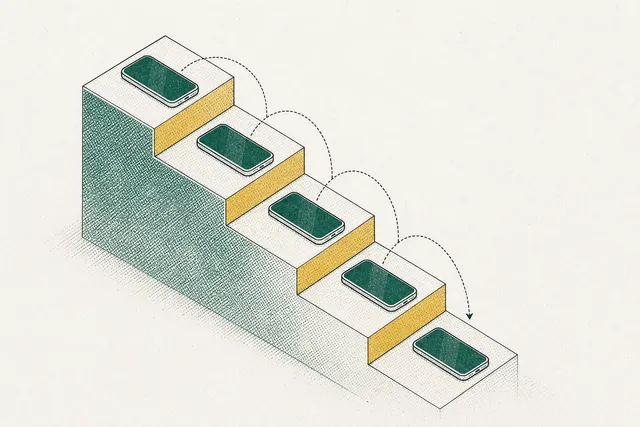
The iPhone has a reputation for holding its value. It still does better than most Android phones, but the numbers from 2025 and 2026 are less flattering than the reputation: a typical iPhone is worth about half its launch price after a year, and some models lose 40% in their first ten weeks.
What the studies say
Two companies publish regular depreciation studies built from the trade-in offers of buyback services. They measure slightly different things, so read them side by side rather than mixing their figures.
| Study | Market and date | Finding |
|---|---|---|
| SellCell | US, June 2026, 12 months | iPhone 16 line kept 51.5% of its value, the best of any brand studied; Samsung 39.5%, Google 40.8% |
| SellCell | US, June 2026, 12 months | Base iPhone 16 kept 51.4%; iPhone 16 Pro Max 256 GB kept 56.4% |
| SellCell | US, June 2026, 12 months | Foldable phones (all brands) lost 64.6% on average, against 55.3% for regular flagships |
| SellCell | US, December 2025, 10 weeks | iPhone Air 256 GB lost 40.3%, 1 TB lost 47.7%; iPhone 17 256 GB lost 33%, 17 Pro Max 26.1% |
| Compare and Recycle | UK, February 2026, 12 months | Average first-year loss: iPhone 13 series 40.1%, 14 series 47.8%, 15 series 55.6%, 16 series 45.1% |
Four patterns worth knowing
The first year costs the most
Both studies agree that the steepest fall comes in the first twelve months, and particularly in the first weeks after a new generation is announced each September. Selling an old iPhone in August rather than October is usually worth more than any negotiation.
Pro Max holds up best
The model that loses the least is consistently the largest Pro: the 16 Pro Max kept 56.4% of its value after a year in SellCell's data, and the 17 Pro Max was the slowest to fall among the 2025 models. Buyers of used phones want the best camera and battery, and pay for them.
The iPhone Air is the outlier
Ten weeks after launch, a 256 GB iPhone Air bought at $999 was worth about 40% less, against 33% for an iPhone 17 bought at the same time. Thin and light is a feature buyers of new phones pay for; buyers of used ones apparently do not. If you like the Air, that is an argument for buying it used later, not for avoiding it. See the iPhone Air page.
Foldables fall fastest
Across all brands, foldable phones lost 64.6% in a year in SellCell's June 2026 study. That predates the iPhone Duo, so nobody knows yet how the first folding iPhone will behave, but a $1,999 phone losing even half of its price is a $1,000 cost of ownership in year one.
What this means when you buy
- Count the resale in the price. At SellCell's rates, a $1,199 iPhone 16 Pro Max cost its owner about $523 in its first year, and a $799 iPhone 16 about $388. The gap between the two shrinks once you count what you get back.
- Buy one year old. A model bought just after the next generation launches has already taken its biggest drop. In the US, Apple itself sold a refurbished iPhone 16 with 256 GB for $739 in October 2026, against $899 for a new 17.
- Watch store prices too. Resale studies measure what you get when you sell. What you pay when you buy also falls over a model's life in retail, a curve you can follow in price drop data from French retailers.
Quick answers
How much is an iPhone worth after one year?
About half its launch price. SellCell found the iPhone 16 line kept 51.5% of its value after 12 months (US, June 2026); Compare and Recycle measured an average first-year loss of 45.1% for the iPhone 16 series in the UK.
Which iPhone holds its value best?
The Pro Max models. The iPhone 16 Pro Max 256 GB kept 56.4% of its value after a year in SellCell's 2026 study.
Do foldable phones lose value faster?
Yes. Foldables of all brands lost 64.6% of their value in a year on average, against 55.3% for regular flagships, according to SellCell (June 2026).